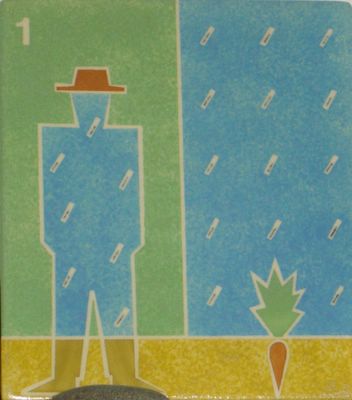
I had never experienced a tropical rain before last evening. Hunter had just returned from a new Chinese restaurant with some carryout when the skies opened. We stood on the balcony and watched as a curtain of rain approached from across the harbor. We toasted our last night in Cairns to the comforting patter of rain around us. This was no passing shower. It went on steady and hard well into the night. How lucky we have been to have the excellent weather we have had. Now it is on to New Zealand.
And for those interested, the bag remains elusive. Hunter is slowly acquiring an entire Billabong wardrobe. [Cowabunga!] First stop in Christ Church ... the pharmacy.
Wednesday, December 26, 2007

Christmas Day
 “What do you need to take out to the reef? Only yourselves!” With those instructions from my crew member I jettisoned my watch AND my glasses and headed out to Michaelmus Cay to snorkel. It is GOOD to live without your watch every once and awhile and just surrender to the wonders of the marine world. It is amazing what I CAN see without my glasses and it is amazing how timeless the world becomes without your watch.

This giant clam is at least 5 feet across


Christmas Eve
Cassowary, fox bats, yellowbellied sun catcher, Jabiru, box stinger, black pudding fruit, dragon lizard … what do these things have in common? When I woke up this morning I didn’t know they existed and with the exception of the Cassowary and the box stinger, I have now met them all. Today’s trip took us into the heart of the Daintree rain forest, a World Heritage Site.
 We saw the yellow bellied sun catcher in its nest which is made from old leaves and feathers and hangs out over the river’s edge suspended from a tree. And there was a stork known as the Jabiru that was circling above the river.
 On our walking tour of the rain forest, we learned about cycads … some of the most primitive trees on the planet.
 They grow VERY slowly and this Macrozamia cycad is probably nearing 1,000 years old. But it looked like a pup next to some of the Mahogany trees we saw stretching up into the canopy. Near the end of our walk we spied a dragon lizard just hanging out on a tree trunk.


Sunday, December 23, 2007
The Art Scene
We departed Ayers Rock by plane to Alice Springs . We would layover there for the day before heading on to Cairns Alice
 I was starting to become familiar with the symbols in this art scene from some of the wall paintings Wally had shown us yesterday. Wall painting is not really the right term. They were blackboards in the rock that were used to teach the children. These symbols were also painted on the body or on a shield or etched in the sand. It wasn’t until the great “assimilation fiasco” of the late 1960’s when various peoples were herded into education camps that an observant art teacher (yea for art teachers!!!) encouraged adults and children to use paint on canvas to tell these stories.

Before we departed "the Alice" for Cairns I dined on a plate of various outback meats. 
Into my bones
Our stay in the outback of central Australia
 base of Uluru and we spent the afternoon with Wally and his interpreter, Chris, learning the stories of Wally’s people. In Anangu culture the parents, who are younger and stronger, leave child rearing to the grandparents who are wiser and older. Parents go off and hunt and gather all day. It is from your grandparents that you learn all the laws and customs and religious beliefs of the society which in the Pitjanjatjura language is called Tjukurpa (chook-orr-pa). Over and over again we were told that Tjukurpa is untranslatable to a Western sensibility. It is more than a religion, more than a set of laws, more than cultural norms … it is an all encompassing way of being in the world that encompasses the past, the present and the future all at the same time.
The stories that are passed on to you by your grandparents become your stories. No one else can tell your story and you cannot tell anyone else’s story. But there are shared stories about creation and what is known as “the dreamtime.” It was this story that Wally told us at the foot of Uluru. Near a water hole at the base of the rock he told a dreamtime story about a two giant pythons where the good giant python (a female with lots of eggs) slays the bad python (a male with lots of poison). As we walked back form the water hole Wally stopped and looked back at the rock and the story again, only THIS time you could see the story in the rock face … the track the female python had taken was a darkened coloration along the rock face, the place where the bad python was slain was a crevice in the rock face, the blood from his smashed head a stain of oxidized discoloration.
The men hunted, the women gathered. When you look out over the landscape it appears there is nothing TO gather. Look again. There are grass seeds that can be made into a paste, grubs at the base of the wichetty tree, bush plums that can be stored in their dried form all year and reconstituted with water, the honey ants who carry honey in their bodies, and of course snake eggs (be sure you know that the hole you are digging in belongs to a non poisonous snake.) Supplement that with the occasional kangaroo, and you have yourself some pretty nourishing “bush tucker.”

Friday, December 21, 2007
The Road. The Reef. The Rock
The three R’s of Australian tourism are the road, the reef and the rock. We are at “the Rock” … Ayers Rock to be precise. Uluru is its aboriginal name and it is considered sacred by the indigenous people.


 I used the buffet as an opportunity to taste some new things. Barramundi (the ever present fish of
Wednesday, December 19, 2007
Some Good Some Bad
.JPG) Good news … we went through an expedited customs in Sydney. Bad news … Hunter’s bag is still in LA. It will do its best to catch up with us was we escape to the Outback in the morning. Bad news … our electrical adaptors are in the LA bag. Good news … we have a voucher to buy up to $200 worth of missing goods. As we talked with a woman to sell us the adaptors she asked “Where are you going in Australia?” And I answered, without missing a beat, “We’re headed out to the Rock tomorrow, then on to the Reef by way of the Alice.” She was very impressed with my ability to speak Australian.
Good news … we went through an expedited customs in Sydney. Bad news … Hunter’s bag is still in LA. It will do its best to catch up with us was we escape to the Outback in the morning. Bad news … our electrical adaptors are in the LA bag. Good news … we have a voucher to buy up to $200 worth of missing goods. As we talked with a woman to sell us the adaptors she asked “Where are you going in Australia?” And I answered, without missing a beat, “We’re headed out to the Rock tomorrow, then on to the Reef by way of the Alice.” She was very impressed with my ability to speak Australian.We spent the afternoon touring the Opera House and taking a ferry ride around the harbor. The Opera House has become THE symbol for Sydney and is now on the World Heritage List.
UAL Flight 839
.JPG)
I have just awakened from a blissful night’s sleep. I rolled over in my wide business class “bed” and raised the window. Pink fluffy clouds race by below … dawn is approaching. My individual flight map tells me we have crossed the international date line AND the equator and are head toward an island called Nadi. I have never heard of it. I am suddenly getting the feel for the Pacific and its vastness. Transatlantic flight is like taking a big giant step from Newfoundland to Ireland …. But THIS … this is BIG.
I have been in the air for nearly 9 hours. I have 4 and a half to go. I see now that the sun has risen. Sydney here we come.
I have been in the air for nearly 9 hours. I have 4 and a half to go. I see now that the sun has risen. Sydney here we come.
Sunday, December 16, 2007
And Away We Go!!!
 So maybe I should have looked at a globe first. This is going to be a loooooooong trip. A little preview ... DC to LA -> LA to Sydney -> Sydney to Ayers Rock and Alice Springs. Then on to Cairns. Then Cairns to Christ Church via Brisbane. Then Christ Church to Auckland ... Auckland to Bangkok and finally Bangkok back to DC via LA on a red-eye.
I make no promises for what I will be able to post here ... but I will certainly try.
Wednesday, November 28, 2007
Reactivation
Right now we are engaged in deep travel preparation for our trip to "down under." It will be the longest time I have ever been away from home. It will be quite the trip starting in Australia --> then New Zealand --> then Thailand, Laos and Malaysia.
What has me obsessed right now is a commitment to traveling LIGHT. One backpack and one rolling suitcase. Can it be done? Stay tuned. Departure scheduled for Monday, December 17.
What has me obsessed right now is a commitment to traveling LIGHT. One backpack and one rolling suitcase. Can it be done? Stay tuned. Departure scheduled for Monday, December 17.
Subscribe to:
Posts (Atom)